- About CelluPro +
- Products +
- Services +
- News Center +
- Contact Us +

Transfection Media Kit
CelliMax® TransCHO Kit02
CelluPro proudly introduces the CelliMax® TransCHO kit02 Transient Transfection Kit-a high performance transient expression platform optimized for CHO cell lines (CHO-S, CHO-K1, etc.). Backed by over a decade of expertise in cell culture medium development, the kit combines high-level protein expression, workflow flexibility, and reliable performance to support rapid candidate screening, recombinant protein characterization, and early-stage process development.
▪ Ultra-high protein expression levels, up to 2g/L.
▪ Compatible with multiple commercial CHO cell lines, including CHO-S, CHO-K1.
▪ A single basal medium for the entire culture process. No medium exchange.
▪ One workflow. No incubation required for transfection complex.
Request a limited free 1 L system standard product and start testing.

Product Information
| Kit Name |
Product Name |
Type |
Cat. No. |
Specification |
Storage |
Format |
| CelliMax® TransCHO Kit02 | CelliMax® CHO P02 Medium | Basal medium | TSCH02 | 1L System |
2-8℃ |
Liquid |
| CelliMax® Uni FM03 Medium | Feed medium | Liquid | ||||
| CelliMax® CHO Enhancer | Enhancer | Liquid | ||||
| CelliMax® CHO Trans Reagent02 | Transfection Reagent | Liquid |
Less Complexity. More Protein.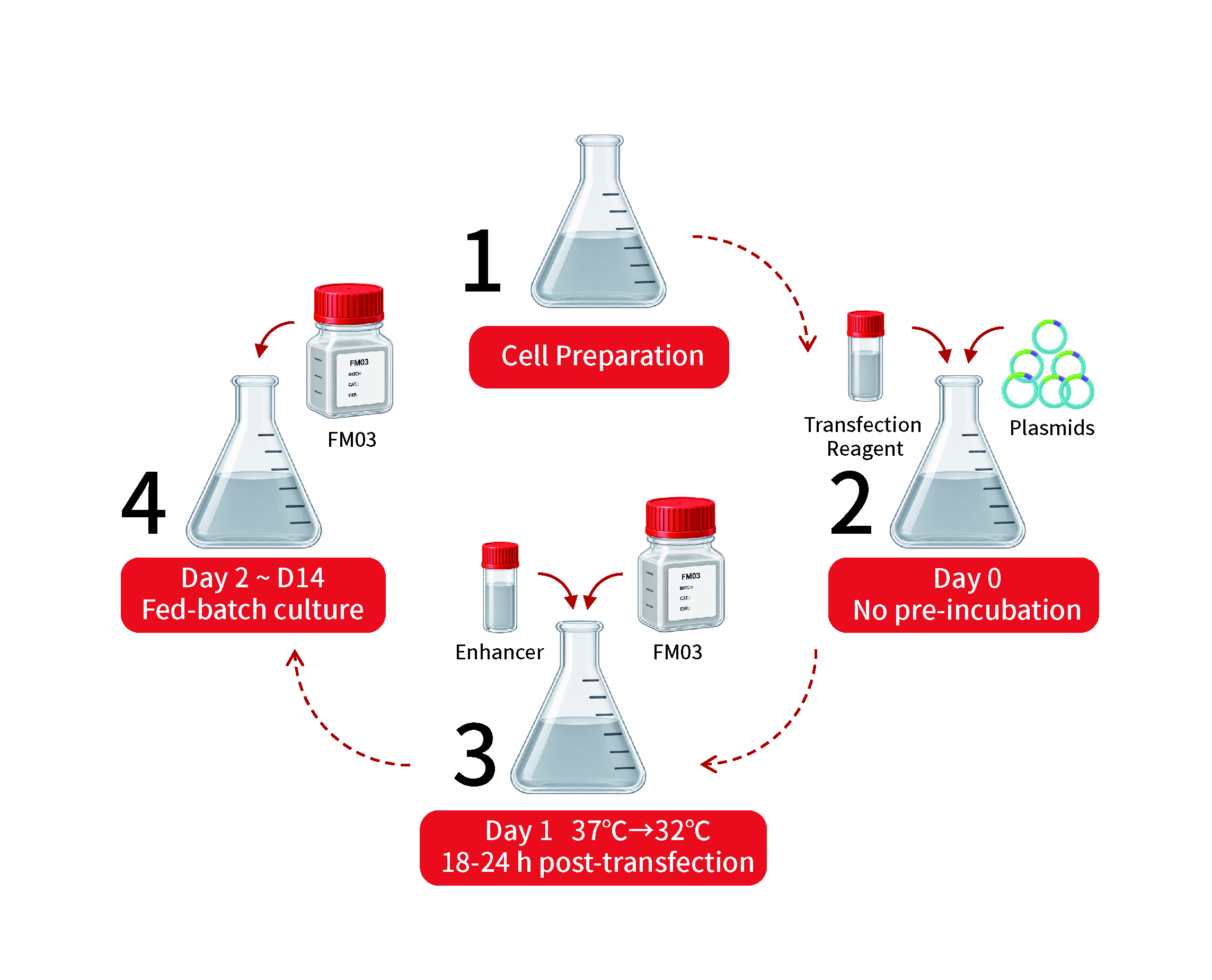
Product Performance
Figure A. Typical Protein Titer Values (mg/L)

Figure B. Typical Cell Growth Performance Values


Request a Free Sample
FAQ
Q1
What is the primary advantage of CelliMax® CHO P02 Medium?


High versatility. CelliMax® CHO P02 Medium is adapted to multiple cultivation processes, covering the entire workflow from cell thawing and passaging to transient transfection, fed-batch cultivation. No medium change is required for the entire duration of culture until harvest.
Q2
Can individual components of the kit be substituted?
No, substitution of components within the kit is not recommended. To achieve maximum protein titer, users are recommended to use all components supplied in the kit. Substitution of any component may impact cell growth and reduce protein yield.
Q3
What are the differences between the two “Cell Preparation for Transfection” methods provided in the instruction manual?
Option 1 has a wide range of applicable scenarios, featuring a straightforward workflow and enabling cultivation scale-up from shake flasks to bioreactors.
Option 2 introduces an additional centrifugation step on the day of transfection (D0), which can further improve the protein expression levels.
Q4
What are the requirements for plasmid DNA?
Two key requirements are recommended:
Transient transfection is highly sensitive to endotoxins, which can induce cellular stress and apoptosis, reduce cell viability, and directly decrease protein yield.
Impurities such as RNA, proteins, and residual salts from plasmid preparation can interfere with the binding between DNA and the transfection reagent, impair complex formation, and reduce plasmid delivery efficiency into cells. In general, plasmid DNA concentration is positively correlated with protein yield.
To achieve optimal performance with CelliMax® TransCHO Kit02, high-purity, high-concentration plasmid DNA is highly recommended.
Q5
Can the dosage of transfection reagent and plasmid DNA be adjusted?
The recommended plasmid DNA concentration is 4.0 μg/mL.
For poorly expressing plasmids, the plasmid DNA concentration may be increased by 1.0–2.0 μg/mL, with the corresponding CHO Trans reagent02 increased to 8.5 μL/mL.
Q6
Why is a temperature shift applied to CHO cells post-transfection?
At high cell density during transient transfection, a temperature shift helps maintain high cell viability and extend culture duration, leading to improve protein expression levels.
Q7
Is glutamine supplementation required when using CelliMax® TransCHO Kit02?
Normally, no additional supplementation is required. CHO P02 Medium and uni FM03 Medium supplied with the kit contain stabilized glutamine, eliminating the need to prepare and add fresh glutamine.
When storage exceeds 6 months before usage, 2–4 mM L‑glutamine may be supplemented into CHO P02 Medium prior to use.
Q8
Notes on glucose supplementation at transient expression.
In general, the glucose addition level specified in the instruction is sufficient to meet cellular demands.
When the peak cell density exceeds 30 × 10⁶ cells/mL, an additional 2 g/L glucose is recommended based on the feed strategy.
If equipment is available to measure glucose concentration in the culture medium, monitor and supplement glucose concentrate daily or every other day to keep residual glucose ≥3 g/L.
Q9
What is the recommended harvest time for cells cultured with CelliMax® TransCHO Kit02?
The optimal harvest time varies depending on the CHO cell line and target protein.
Cells transfected with CelliMax® TransCHO Kit02 maintain high viability post-transfection, supporting a culture duration and protein yield comparable to those achieved in fed-batch cultures. In general, protein titer increases with extended culture time.
For optimal protein quality, harvest at Viability > 60% or Days 14~15 post-transfection.